A practical guide to managing competing demands without sacrificing wellbeing or performance
Every workday seems to start the same way. You open your inbox, check your task list, glance at your calendar – and immediately feel the weight of everything that needs to be done. There are urgent requests from leadership, overdue deliverables, meetings that could have been emails, and a growing backlog of work that never quite makes it to the top of the list.
The instinct is to work faster, stay later, or just push through. But speed without strategy doesn't solve the problem, it compounds it. What most people need isn't more hours in the day. It's a clearer system for deciding what actually matters.
Prioritisation isn't just a productivity skill. It's a wellbeing skill. And when done well, it's one of the most effective defences against burnout.
Why Most Prioritisation Methods Don't Work
If you've ever tried to prioritise your workload using a simple to-do list, you'll know the problem: everything feels important. The list gets longer, not shorter. And the sense of being overwhelmed doesn't go away – it just gets rewritten in increasingly untidy handwriting.
The issue isn't a lack of organisation. It's a lack of clarity about what truly deserves your finite time and energy. Most people prioritise based on whoever is asking the loudest, what feels most urgent in the moment, or what generates the least friction. None of these methods address the underlying question: what actually moves the needle?
Effective prioritisation requires stepping back and applying a framework – not to eliminate all the work, but to make deliberate choices about where to focus first.
"Saying yes to everything is the same as saying no to what matters most."
Start With Clarity: What Are You Actually Trying to Achieve?
Before you can prioritise tasks, you need to be clear about outcomes. Not activities – outcomes. What result does this work need to produce? What changes if it's done well, or not done at all?
This is harder than it sounds, because many of us are given tasks without clear context. You're asked to prepare a report, attend a meeting, or respond to a request, but the why behind it is vague. In the absence of clarity, everything defaults to equal importance.
A simple habit that changes this: before adding anything to your workload, ask what success looks like for this task. If the answer is unclear, clarify it before you start. If the person asking can't articulate what success looks like, that's a signal the task itself may not be as critical as it appears.
The Eisenhower Matrix: Simple, Effective, Underused
One of the most enduring prioritisation frameworks is the Eisenhower Matrix, which categorises tasks based on two dimensions: urgency and importance.
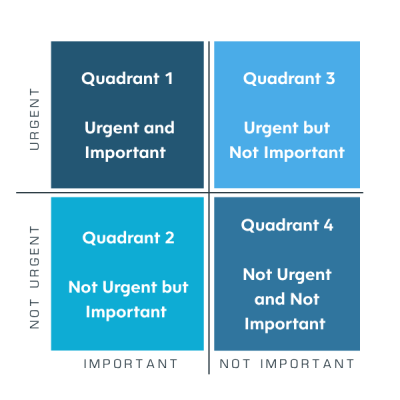
Quadrant 1: Urgent and Important
These are genuine crises – things that must be handled now and matter to your core responsibilities. A client escalation. A system outage. A deadline that's non-negotiable. Do these first.
Quadrant 2: Not Urgent but Important
This is where high-value work lives: strategic planning, relationship-building, skill development, process improvement. These tasks don't scream for attention, so they get pushed aside - but they're the work that actually drives long-term results. Schedule dedicated time for these, or they'll never happen.
Quadrant 3: Urgent but Not Important
These are the tasks that feel pressing but don't align with your actual priorities. Someone else's emergency. A meeting you don't need to attend. Low-value requests disguised as high-priority. Delegate these when possible or decline them when not.
Quadrant 4: Not Urgent and Not Important
Busy work. Distractions. Tasks that exist because they've always existed, not because they add value. Eliminate these ruthlessly.
The matrix isn't about doing everything – it's about making conscious trade-offs. Most people spend their time in Quadrants 1 and 3. The goal is to shift more energy into Quadrant 2, where the real work gets done.
The 80/20 Rule: Focus on What Actually Moves the Needle
The Pareto Principle – commonly known as the 80/20 rule – suggests that roughly 80% of outcomes come from 20% of efforts. In a work context, that means a small number of tasks on your list are responsible for the majority of your results.
The practical application is this: identify the 20%. What are the two or three things on your plate right now that, if done well, would make the biggest difference? Those go to the top. Everything else is secondary.
This doesn't mean the other 80% doesn't matter – it means it doesn't matter as much. And if you're operating at full capacity, something has to give. Better to make that choice deliberately than to spread yourself so thin that nothing gets done well.
"Prioritisation is not about doing more. It's about doing less - but better."
Time Blocking: Protect Your Focus, Not Just Your Calendar
Once you've identified your priorities, the next challenge is protecting the time to actually work on them. This is where time blocking comes in – the practice of assigning specific tasks to specific time slots, rather than leaving your day open to whoever or whatever demands attention first.
Here's how it works in practice. Look at your week ahead. Block out time for your Quadrant 2 work – the important but not urgent tasks that tend to get squeezed out. Treat those blocks as non-negotiable. If someone asks for a meeting during that time, the answer is the same as if you already had a client meeting: you're not available.
Time blocking also creates realistic visibility into your capacity. If you block out your committed work and discover there's no space left for a new request, that's data – not a personal failing. It's the signal you need to have a conversation about priorities, trade-offs, or resources.
Learn to Say No (And How to Say it Well)
Prioritisation inevitably means saying no to some things. And for many people, that's the hardest part – especially in cultures where responsiveness and availability are mistaken for professionalism.
But here's the reality: every yes to something low-value is a no to something high-value. Your time is finite. Pretending otherwise doesn't make you more capable – it makes you less effective.
Saying no doesn't have to be blunt or combative. It can be clear and respectful. A few approaches that work:
- "I'd like to help with this, but I'm currently committed to X and Y. If this is a higher priority, which one should I deprioritise?"
- "I don't have capacity to take this on right now. Can we revisit this in two weeks, or is there someone else better placed to handle it?"
- "I can do this, but it will mean pushing back the deadline on Z. Does that work for you?"
The key is offering transparency, not excuses. When you articulate what you're already committed to, most reasonable people will respect the boundary.
Review and Recalibrate Regularly
Workloads shift. Priorities change. What mattered last week might be less relevant this week. That's why prioritisation isn't a one-time exercise – it's an ongoing practice.
Build a weekly review habit. Set aside 20 minutes at the start or end of each week to assess what's on your plate, what's moved, and what needs to shift. Ask yourself:
- What are the top three outcomes I need to deliver this week?
- What can I delegate, defer, or decline?
- Where am I overcommitted, and what needs to be renegotiated?
This kind of regular recalibration prevents the slow accumulation of low-value work that eventually leads to overwhelm. It keeps you responsive without being reactive.
Prioritisation is a Burnout Prevention Strategy
The link between poor prioritisation and burnout is direct. When people try to do everything, they end up doing nothing particularly well – and the psychological cost of constant underperformance, missed deadlines, and feeling perpetually behind compounds over time.
Burnout isn't just about working too much. It's about working on too many things that don't align with your actual capacity, your actual priorities, or your actual impact. Effective prioritisation addresses that at the source.
Ready to Go From Overwhelmed to in Control?
Smarter prioritisation is a powerful first step, but when burnout has already taken hold, it takes more than a better to-do list to turn things around.
Burnout to Breakthrough™ delivered by MiTraining's evidence-based corporate workshop that helps leaders and teams understand the real drivers of burnout, build resilience under pressure, and create healthier, more sustainable ways of working before it becomes a crisis.
Enquire about Burnout to Breakthrough™ and take the first step toward a workplace where people don't just cope – they thrive.